If you walk into any modern manufacturing facility these days, there’s a good chance you’ll see a collaborative robot—often called a cobot—working side by side with human employees, not behind a safety cage. At our company, we’ve spent years not just building reliable, flexible cobots that integrate seamlessly into existing workflows, but also helping teams feel confident, capable, and excited to work with them. Training isn’t an afterthought for us; it’s the foundation that turns a new cobot investment into a long-term productivity boost. Over the hundreds of deployments we’ve supported across small machine shops, automotive parts factories, and even medical device assembly lines, we’ve refined a training approach that meets employees where they are, addresses real-world fears, and sets everyone up for success. Let me break down what that looks like. Collaborative Robots

First, we start with pre-deployment conversations long before a cobot is ever installed on the shop floor. Too often, companies wait to train their teams until the day the robot arrives, which leaves little time to address concerns that have built up around “robots taking jobs” or “robots being too hard to control.” Our training team sits down with everyone from line workers to shift supervisors to operations managers to ask two key questions: What frustrates you most about your current tasks, and what are you curious about when it comes to working with cobots? I remember a small job shop in Ohio a few years back where a group of senior mill operators told us they were tired of standing for 10 hours a day loading and unloading lathes—work that led to chronic knee and back pain. That context changed everything: instead of framing the cobot as a replacement, we framed it as a tool to take over the repetitive, physically taxing part of the job, so operators could focus on quality checks, problem-solving, and tasks that actually use their years of expertise. For newer employees who might be more comfortable with basic tech, we also hear excitement about learning new skills that could advance their careers. These pre-deployment chats aren’t just nice to have—they’re critical to building buy-in, because when employees understand how a cobot improves their day-to-day work, they show up to training ready to engage, not resist.
Next, we tailor our training to different roles, because not every employee needs—or wants—the same level of knowledge. Line operators, who will work directly next to the cobot, need hands-on, practical skills: how to start and stop the robot, how to pause it if something goes wrong, how to swap out simple tooling, and how to recognize basic error messages. We teach these skills in our training center, where we set up mock workcells that mirror real shop floor setups—complete with background noise, typical part sizes, and even common workflow disruptions like a part that’s slightly misaligned. We don’t use jargon-heavy manuals or lectures; we have operators practice small, achievable tasks in the first session: “Program the cobot to move from Point A to Point B to pick up a part,” “Reset the cobot after a minor error.” By the end of the first half-day, they’re not just watching a demo—they’re moving the robot themselves, making small adjustments, and feeling in control. For supervisors, we focus on workflow integration, scheduling, and troubleshooting common issues that pop up when a cobot is added to an existing line. We also teach how to track key metrics, like cycle time and error rates, so they can measure how the cobot is impacting productivity. For maintenance teams, we go deeper into technical training: how to perform routine checks, replace wear parts, and troubleshoot more complex electrical or software issues. This role-specific approach means no one is overwhelmed with information they’ll never use, and everyone leaves training with clear, actionable steps for their job.
A big part of our training that sets it apart from generic cobot courses is our focus on safety. Cobots are designed to be safe around humans—they have force-sensors that stop movement if they touch something, lightweight frames that don’t cause serious injury, and speed limits for collaborative environments—but that doesn’t mean workplaces can skip training on safe operation. We start with the basics: how the cobot’s safety features work, why they react the way they do, and what employees should do if the cobot triggers a stop. We use real, relatable scenarios to make this stick. For example, we’ll set up a mock workcell where an operator accidentally leaves a wrench near the cobot’s path, and walk through how the safety sensor would react, how to reset the system, and what steps to take to avoid that mistake again. We also cover ergonomics—another big concern for teams working alongside cobots. We teach how to adjust the cobot’s reach, height, and speed to fit the task and the needs of the workspace, so it complements human work, not disrupts it. One of our customers in the consumer goods industry told us after training that their line operators started using the cobot to lift heavy boxes that had previously required two people, which cut down on workplace injuries by 20% in the first six months. That’s the kind of impact that comes from teaching safety as an integral part of how the cobot works, not just a set of rules to follow.
We also emphasize hands-on, guided learning over virtual simulations or theory-heavy lessons. I’ve seen too many training programs that spend hours on slides about cobot mechanics, only for employees to walk away unable to actually program a simple task. At our training facilities, every session has a 70/30 split of hands-on practice to instruction. For example, when teaching basic programming, we use a tablet-based interface that’s designed to be intuitive, no coding experience required. Operators don’t have to write lines of text to tell the cobot what to do—they just move its arm to the desired points, and the software records the path. We walk them through this step by step, pausing to answer questions, and let them make mistakes in a low-stakes training environment before they try it on the real workcell. We also encourage “play time” during training: after covering the core tasks, we let employees experiment with small changes, like adjusting the speed of the cobot or adding a new part to the workflow, so they feel comfortable exploring and adapting. A recent customer in the agricultural equipment sector told us that their operators spent extra time during training testing different part orientations for the cobot, which ended up making their assembly process more efficient than the original plan we’d proposed. That kind of innovation only happens when employees feel confident enough to experiment.
Post-training support is just as important as the training itself, because the real test of cobot success happens when employees are back on the shop floor, dealing with real, unplanned issues. We don’t just hand over a manual and disappear after the training session. Every customer gets access to a dedicated support team that can answer questions via phone, email, or even a video call where we can walk through a problem in real time. We also offer follow-up refreshers, which are especially helpful for teams that only use the cobot for certain tasks (like high-volume assembly during peak seasons) and might not use it every day. Many of our customers schedule these refreshers after 30 days and 90 days, when employees have had time to work with the cobot and run into small issues they weren’t sure how to solve. We also create custom quick-reference guides tailored to each customer’s workcell—no generic manuals full of terms they don’t need. For example, a medical device customer gets a guide focused on cleaning the cobot’s tooling to meet hygiene standards, while an automotive customer gets a guide focused on switching between different part types for their assembly line. These quick guides are taped up near the workcell, so operators can glance at them instead of scrolling through a long document.
Another key part of our approach is involving senior employees and mentors in the training process. We know that line operators with 20 or 30 years of experience have invaluable knowledge about their work, and when they feel like their expertise is being respected, they’re more likely to embrace the cobot. We often pair these senior operators with newer employees, or with our training specialists, so they can share their insights while learning how to work with the cobot. At a metal fabrication customer in Detroit, the senior operators initially were skeptical of the cobot, worrying that it would replace their knowledge of part quality. But during training, we set up an exercise where the cobot picks up parts and the operator checks for defects. The senior operators quickly realized that the cobot could handle the repetitive part of picking and placing, freeing them up to focus on the detailed quality checks that only their experience could catch. A few months later, those same operators were helping train new hires on the cobot, and even suggesting small adjustments to the workflow that made the whole process run smoother. This kind of peer mentorship turns early skepticism into advocacy, which makes the long-term adoption of the cobot much easier.
We also recognize that every workplace is different, so our training is never a one-size-fits-all program. A small business with 10 employees will have very different needs than a large manufacturing plant with 200 workers. For small businesses, we offer compact, on-site training that can be completed in a single day, since they often don’t have a dedicated training space. For larger facilities, we can train groups of operators in a dedicated space at our training center, or bring our specialists on-site over a few days to train multiple shifts. We also adjust the complexity of the training based on the tasks the cobot will be doing. If a cobot is only doing simple pick-and-place tasks, the training is focused on those core skills. If it’s doing more complex tasks like precision assembly or quality inspection, we go deeper into programming and troubleshooting. For example, a customer that uses cobots for soldering circuit boards needed training that covered not just basic operation, but also how to adjust the cobot’s path to account for slight variations in board size. Our team worked with their engineers to create a custom training module that focused on those specific tasks, so the operators felt fully prepared to handle their unique workflow.
At the end of the day, training employees to work with cobots isn’t about teaching them to be robot technicians—it’s about empowering them to use a new tool to do their jobs better. Over the years, we’ve seen this approach pay off: employees who once dreaded repetitive tasks now feel more engaged, with less physical strain and more opportunities to learn new skills. We’ve helped teams increase productivity by up to 30% while cutting workplace injuries related to manual material handling, all because they felt confident and comfortable working with their cobots.
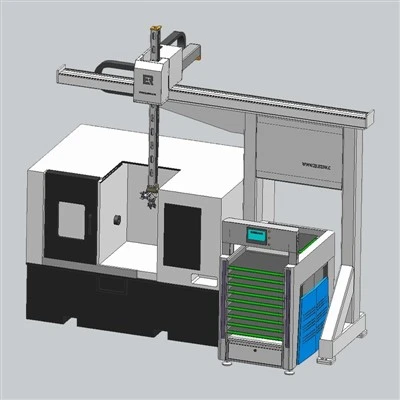
If your team is considering adding collaborative robots to your workflow, we’re here to help every step of the way. We can walk you through pre-deployment planning, tailor a training program to your roles and tasks, and provide ongoing support long after the cobot is installed. Connect with our team to learn more about how we can help your employees and cobots work together successfully.
CNC Machine Tending Pallet Magazine References:
- International Federation of Robotics. (2023). Collaborative Robots: Safety and Training Guidelines for Industrial Workplaces.
- OSHA. (2022). Ergonomics Guidelines for Manufacturing Facilities Implementing Collaborative Robotics.
- Rooker, M., & Bifull, G. (2021). Employee Training Frameworks for Human-Robot Collaboration in Small and Medium Enterprises.
- Manufacturing Extension Partnership. (2022). Best Practices for Integrating Cobots into Existing Production Lines.
Zhejiang Luban Automation Technology Co., Ltd.
As one of the most professional collaborative robots manufacturers and suppliers in China, we also support customized service with low price. With abundant experience, we warmly welcome you to wholesale high quality collaborative robots for sale here from our factory.
Address: No.19-27-2, Zhonggang Avenue, Huaxi Subdistrict, Changxing County, Huzhou City, Zhejiang Province
E-mail: sales@luban-zdh.com
WebSite: https://www.multilayermagazine.com/
